How to Use the Seoul Subway: T-money, Fares, Transfers, and Apps (2026)
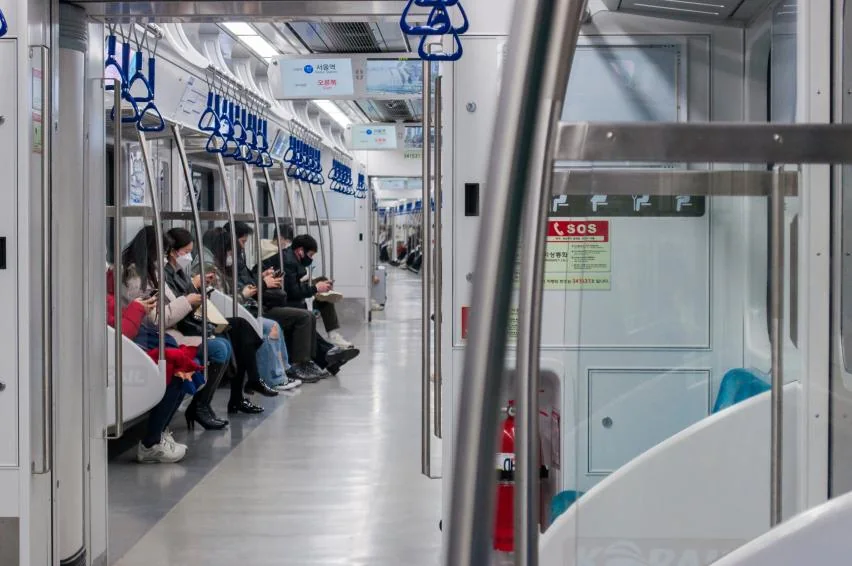
If Seoul is your first stop in Korea, the subway may look complicated for about five minutes. After your first ride, it is usually the easiest and most predictable way to cross the city.
The basic system is simple: buy or load a transportation card, search your route in a local map app, follow the line color and station number, tap in, transfer without leaving the paid area, and tap out at your destination.
This guide explains how to use the Seoul subway in 2026, including T-money, current fares, transfers, ticket machines, route apps, and the mistakes that cost first-time visitors time.
Quick Answer: The Easiest Setup for Most Visitors
For most travelers, the easiest setup is a T-money card plus NAVER Map.
- Buy a T-money card at a convenience store or subway information center.
- Load KRW 10,000–20,000 to start.
- Use NAVER Map to find the correct line, direction, transfer station, and exit.
- Tap the card at the gate when entering and leaving.
- The adult base subway fare is KRW 1,550 with a transportation card for the first 10 km.
You normally cannot tap an ordinary foreign Visa or Mastercard directly at the subway gate. Since March 17, 2026, however, international cards are accepted at newer machines in many Lines 1–8 stations for single-journey tickets and short-term Climate Card purchases or recharges. That is a ticket-machine payment option, not open-loop payment at the gate.
Which Subway Card Should You Use?
On mobile, swipe left or right to view the full comparison table.
| Option | Upfront cost | Bus transfers | Best for | Main drawback |
|---|---|---|---|---|
| T-money | Usually KRW 3,000–5,000 for the card, then pay per ride | Yes | Most visitors and trips beyond Seoul | Requires stored balance; standard top-ups may still require Korean won cash |
| Single-journey ticket | Fare plus refundable KRW 500 deposit | No | One subway ride or travelers without a transit card | Subway only; must return the ticket for the deposit |
| Climate Card short-term pass | KRW 3,000 physical card plus KRW 5,000–20,000 pass | Yes, within the service area | Visitors taking many rides inside Seoul | Coverage exclusions; pass activates immediately |
T-money: Best for Most First-Time Visitors
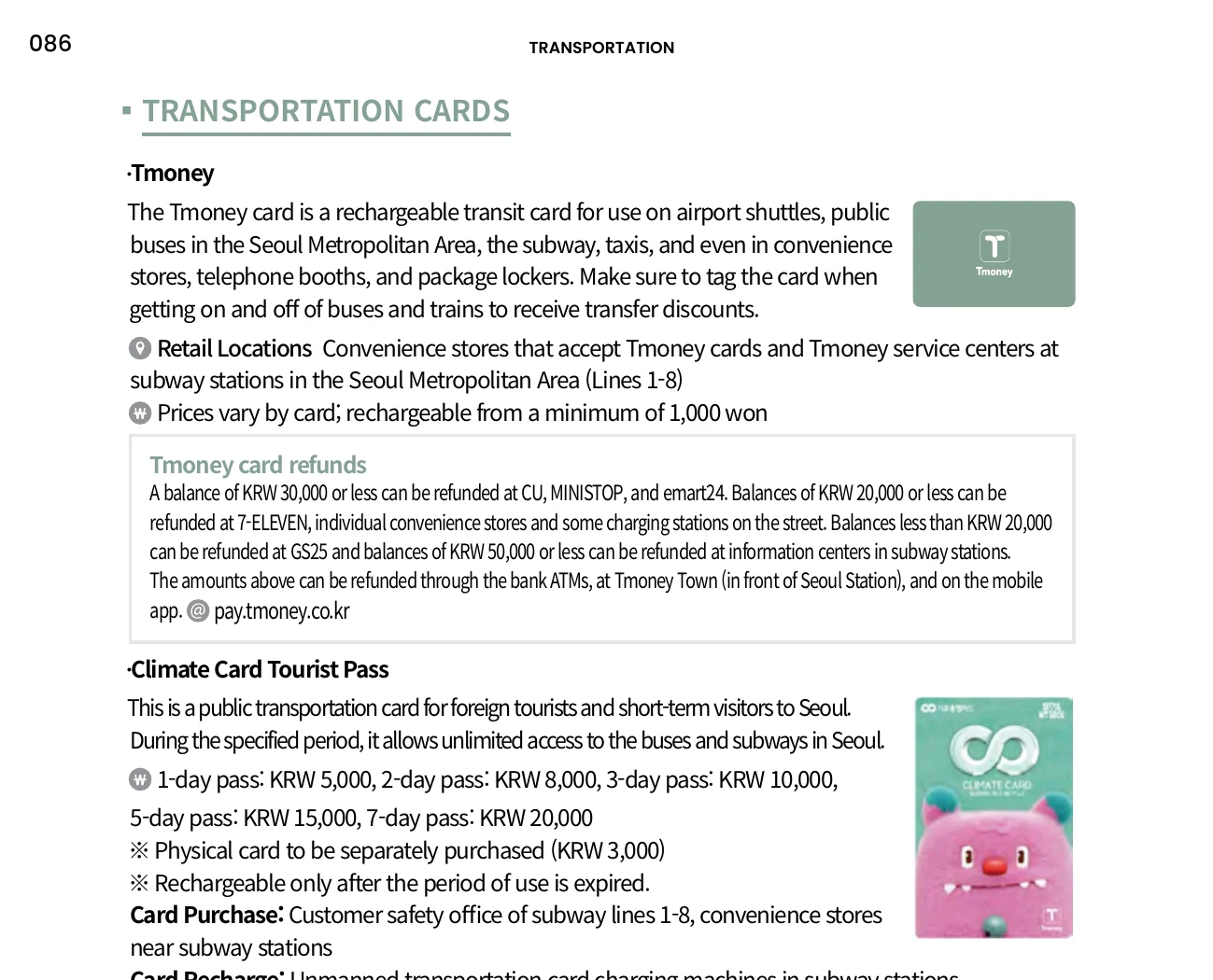
T-money is a rechargeable transit card used on Seoul subways, city buses, many taxis, the AREX all-stop train, and public transportation in many other parts of Korea. It also works at participating convenience stores and other retailers displaying the T-money logo.
Cards usually cost KRW 3,000–5,000, depending on the design. The card price and the stored travel balance are separate. You can buy one at convenience stores such as CU, GS25, and 7-Eleven, or at information centers in Seoul subway stations on Lines 1–8.
At a subway station, switch the ticket or recharge machine to English, place the card on the reader, choose the amount, and pay. Many standard T-money top-ups still work most reliably with Korean won cash, so keeping a few KRW 10,000 notes is useful.
For a short trip, do not load too much. KRW 10,000–20,000 is a practical starting balance, and you can add more later. Small remaining balances can be refunded at participating convenience stores, while refunds over KRW 50,000 require Tmoney Town near Seoul Station. The physical card price is generally not part of the balance refund.
Single-Journey Ticket: Fine for One Ride
Every subway station has multilingual ticket machines. Select your destination, pay the fare and a KRW 500 deposit, and collect the single-journey card.
The adult base fare is KRW 1,650, so a basic trip requires KRW 2,150 at purchase. After you arrive and leave the gate, insert the card into a deposit refund machine to get the KRW 500 back.
A single-journey ticket works on the subway only. It does not provide the bus-subway transfer discount, so it is less convenient if you will use public transportation more than once.
Climate Card: Consider It for Heavy Seoul Travel Days
The Climate Card short-term pass allows unlimited rides on covered Seoul subway sections and Seoul-licensed buses during the selected period.
- 1 day: KRW 5,000
- 2 days: KRW 8,000
- 3 days: KRW 10,000
- 5 days: KRW 15,000
- 7 days: KRW 20,000
- Physical card: KRW 3,000 separately
The pass becomes active when it is loaded, so do not activate it the night before you plan to use it. It excludes the Sinbundang Line, GTX, airport and intercity buses, non-Seoul buses, and some stations outside its service area.
For a first-time buyer, a one-day pass costs KRW 8,000 including the physical card. That means it usually pays off only on a busy day with roughly six short subway rides. It can still be worthwhile for convenience, but T-money is safer when your itinerary crosses outside Seoul or includes only two or three rides a day.
How to Ride the Seoul Subway Step by Step
1. Search the Destination, Not Just the Station
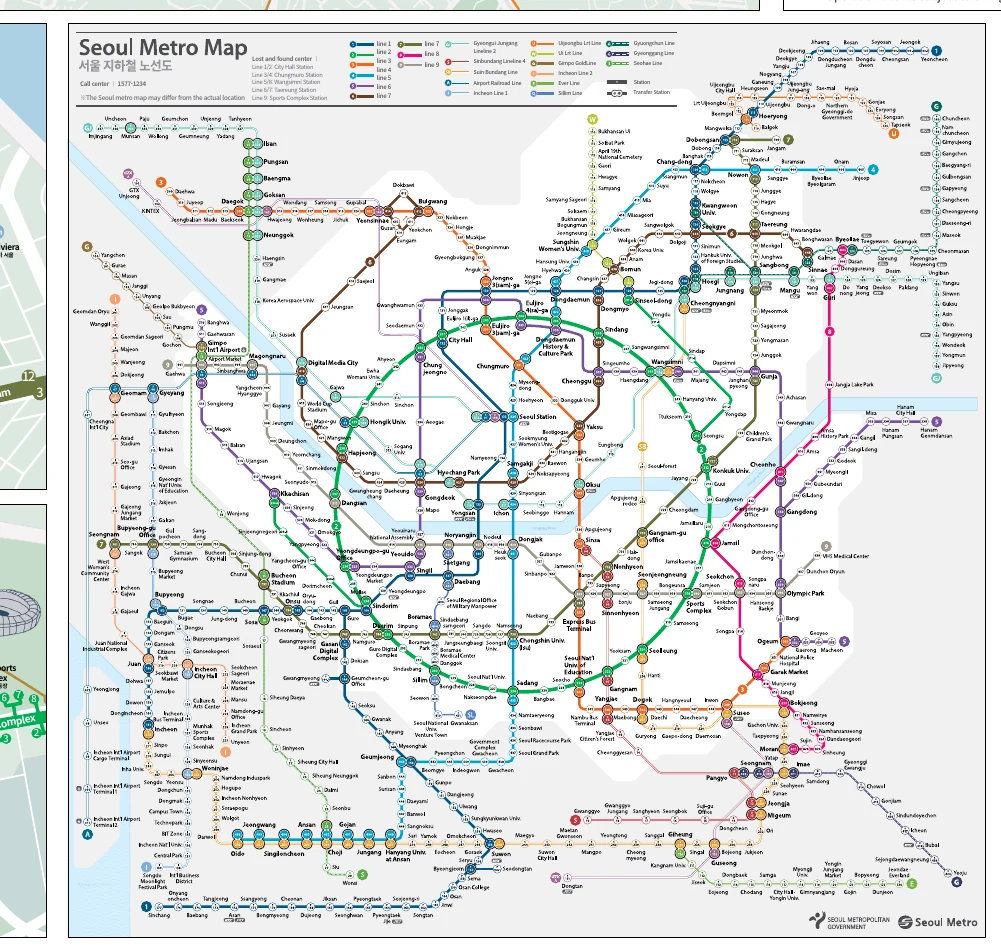
Open NAVER Map and search for the actual attraction, restaurant, or hotel. The app will identify the nearest station and the best exit. This matters because large stations can have more than ten exits, and choosing the wrong one can add a long street-level walk.
Before entering the station, note four things:
- Subway line number and color
- Departure station number
- Transfer station, if any
- Destination exit number
Station numbers are especially useful because English spellings can look similar at a glance.
2. Find the Correct Line and Direction
Inside the station, follow signs for the line number and color. Platform signs usually show direction by listing major stations or the terminal station, not simply northbound or southbound.
Check the next one or two station names in your app and compare them with the platform sign. If the next station is wrong, you are on the opposite platform.
Some trains share tracks but have different final destinations, and some services run express. Look at the platform display before boarding if your route uses Line 1, Line 9, the airport railroad, or another route with service variations.
3. Tap In Once
Place your T-money or Climate Card flat against the reader until the gate opens. The screen shows the fare or remaining balance.
If the gate beeps and stays closed, try the card once more without moving it. If it still fails, use the nearby call button or show the card to station staff. Do not repeatedly force the gate.
4. Transfer Without Leaving the Paid Area
At a transfer station, follow the colored signs for the next line. You usually do not tap out and buy another fare. The transfer corridors can be long, especially at large stations such as Seoul Station, Jongno 3-ga, Express Bus Terminal, and Dongdaemun History & Culture Park.
The integrated fare system charges one base fare and then calculates any additional distance. A transfer is therefore not always literally free, but you avoid paying another full base fare when the trip qualifies.
5. Tap Out and Use the Correct Exit
Tap the same card at the destination gate. Then follow the numbered exit sign from your route app.
If your card has insufficient balance, look for a fare-adjustment or recharge machine before the exit gate. Station staff can also help. Do not discard a single-journey card: return it at the deposit refund machine after leaving the gate.
Seoul Subway Fares and Transfer Rules in 2026
The adult base fare for the Seoul metropolitan subway is KRW 1,550 with a transportation card and KRW 1,650 with a single-journey ticket for the first 10 km.
Longer trips cost more. The fare increases by KRW 100 in distance bands after the base range. For most sightseeing journeys within central Seoul, the total is still close to the base fare.
Card users receive a 20% early-morning discount on the first ride before 6:30 AM. The discounted adult base fare is KRW 1,240.
How Transfers Work
The Seoul integrated fare system allows up to four transfers, meaning five consecutive boardings, when the rules are met.
- Make the next boarding within 30 minutes after tapping off.
- The window increases to 60 minutes from 9 PM to 7 AM.
- Always tap when getting on and off a bus.
- Use the same transportation card throughout the journey.
- A single-journey subway ticket does not qualify for a bus transfer.
When transferring between subway lines inside a station, follow the transfer signs and stay inside the paid area. When transferring from subway to bus or bus to subway, the tap-off and time-window rules determine the discount.
Best Apps for the Seoul Subway
NAVER Map: Best All-Round Choice
NAVER Map is my first recommendation for international visitors because it combines subway, bus, walking, and place search. It can show real-time arrivals, boarding and exit guidance, alternative routes, and the walking path from the station to your final destination.
Set the app language to English before your trip. If an English place name does not appear, copy the Korean address or Korean place name from the venue’s official page and paste it into NAVER Map.
Seoul Subway Official App: Best for Station Details
Seoul Metro’s official Seoul Subway app provides an English line map, route search, real-time train information, congestion data, station exits, restrooms, and transfer guidance. It is a useful second app when you need platform-level detail or want to check the first or last train.
KakaoMap: Strong Alternative
KakaoMap provides public-transit and walking routes using frequently updated local data. It can also send boarding and alighting notifications. If you already use Kakao services, it is a practical alternative to NAVER Map.
Common First-Time Mistakes
Using Only a Foreign Bank Card
Do not assume that contactless Visa or Mastercard will open the gate. Buy a transportation card or a single-journey ticket first. New international-card machines are helpful, but they are a way to buy supported tickets and short-term passes.
Following the Line Color but Ignoring Direction
Being on the correct line is only half the job. Compare the next station in your app with the platform display before boarding.
Exiting During a Transfer
Follow signs marked Transfer and the next line number. Passing through a normal exit gate can end the current fare journey.
Choosing the Wrong Exit
Large stations cover several city blocks. Check the exit number before you reach street level, especially when carrying luggage or meeting someone.
Forgetting to Tap Off the Bus
Subway gates force you to tap out, but buses do not. Always tap when leaving a bus or you may lose the transfer discount and be charged incorrectly on the next trip.
Luggage, Elevators, and Rush Hour
Most major stations have elevators or escalators, but the closest accessible exit may not be the closest exit on a standard route. Check station facility information in NAVER Map or the Seoul Subway app before you travel with a wheelchair, stroller, or large suitcase.
Avoid the busiest weekday periods if you can, particularly around 7:30–9:00 AM and 5:30–7:30 PM. Transfers are much easier outside commuter peaks.
If you have several large bags, traveling from Incheon Airport by subway may be cheap but not always comfortable. Compare the airport railroad, bus, taxi, and transfer options in our Incheon Airport to Seoul guide.
Uncle Choi’s Tip
Take a screenshot of your route before entering the station. Include the line number, transfer station, final direction, and exit number. Mobile data usually works underground, but a saved screenshot removes stress when you are standing in a busy transfer corridor.
Also, do not judge a route only by total minutes. A trip with one easy transfer is often better than a route that saves three minutes but requires two long transfers.
Frequently Asked Questions
Can I use a foreign credit card on the Seoul subway?
You generally cannot tap an ordinary foreign credit card directly at the subway gate. Use T-money, another compatible transportation card, a Climate Card, or a single-journey ticket. Since March 17, 2026, international Visa and Mastercard payments are available at newer machines in many Lines 1–8 stations for single-journey tickets and short-term Climate Card transactions.
How much is one Seoul subway ride in 2026?
The adult base fare is KRW 1,550 with a transportation card or KRW 1,650 with a single-journey ticket for the first 10 km. A single-journey card also requires a refundable KRW 500 deposit at purchase.
Where can I buy a T-money card?
Buy one at major convenience stores such as CU, GS25, and 7-Eleven, or at information centers in Seoul subway stations on Lines 1–8. General card designs usually cost KRW 3,000–5,000 before adding travel balance.
Can I use T-money on buses and the airport railroad?
Yes. T-money works on Seoul city buses and the AREX all-stop train, as well as subways, many taxis, and public transportation in many other Korean cities. It is not the ticket for the AREX Express Train’s reserved-seat service.
How much should I load on T-money?
KRW 10,000–20,000 is a sensible starting balance for a short Seoul visit. Add more when needed rather than loading a large amount that you later have to refund.
Does the Seoul subway run 24 hours?
No. First and last train times vary by station, direction, day, and final destination. Check NAVER Map or the official Seoul Subway app on the day you travel, especially after 11 PM.
What should I do if I enter the wrong gate or platform?
Ask station staff before exiting and re-entering on your own. Show them the station or destination in your map app. Re-entry rules differ by station and line, so staff assistance is the safest option.
Final Recommendation
For most first-time visitors, use T-money for payment and NAVER Map for navigation. Load a modest amount, check the line number and next station before boarding, stay inside the paid area when transferring, and confirm your exit number before reaching the street.
Choose a single-journey ticket only for an occasional ride. Choose a short-term Climate Card when you will make many rides inside its coverage area and have checked that your itinerary does not use excluded lines or stations.
Once you complete one trip, the Seoul subway becomes much easier than the map first suggests.
Sources & Last Updated
Last fact-checked: August 21, 2026
- Seoul Metropolitan Government — Subway fares and transfer rules
- VISITKOREA — Transportation cards
- Seoul Metropolitan Government — Climate Card
- Seoul Metropolitan Government — International cards at new transit ticket machines
- Seoul Metropolitan Government — Public transportation and Seoul Subway app
- NAVER Map — Public transportation help
Image Credits
- Featured image: © Seoul Tourism Organization / Seoul Tourism Archive, CID ARP007l91, Korea Open Government License Type 1
- Transportation-card image: Seoul Tourism Organization, 2026 Seoul Official Tourist Guide
- Subway map: Seoul Tourism Organization and Seoul Metro, 2026 Seoul Tourist Map